

Ego Sum
from the Office for the Solemnity of the Most Holy Body and Blood of Christ (Corpus Christi)
(June 2026)
Right click here to download audio

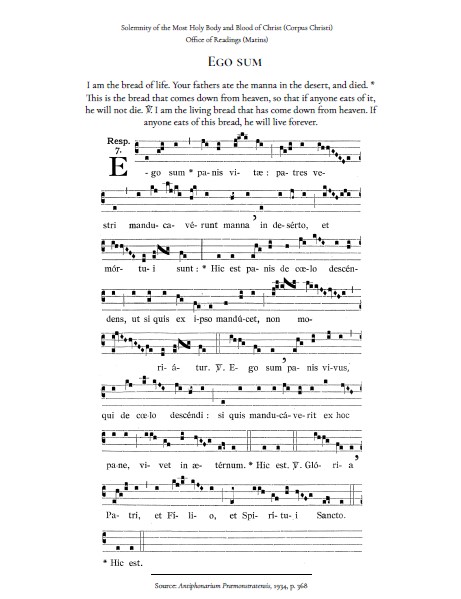
“I am the bread of life...”
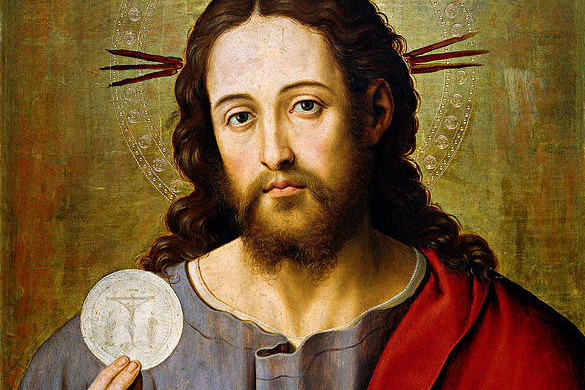
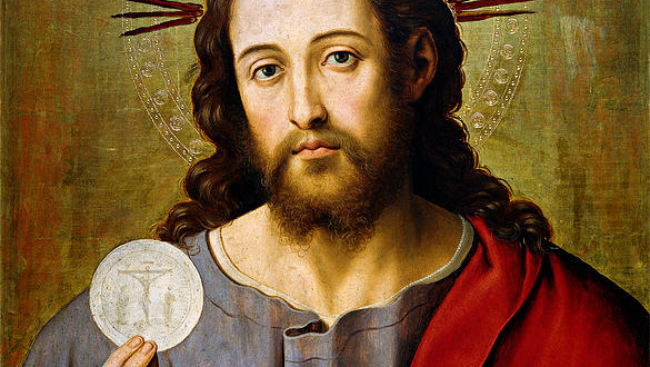
W ith these words, we begin the responsory featured this month, which is chanted at Matins on the Solemnity of Corpus Christi. They are taken from Christ’s proclamation to the crowds in John 6, foreshadowing his declaration to the disciples at the Last Supper, “This is My Body.”
Christ is truly and substantially present in the Holy Eucharist, fulfilling all the Old Testament promises that God Himself would dwell among men, for his “delight is to be with the children of men” (Proverbs 8:31).
“This is the bread that comes down from heaven, so that if anyone eats of it, he will not die.”
In the Old Covenant, the Israelites ate manna in the desert but still died. The manna was but a foreshadowing of Christ, the true bread from heaven, who came to conquer death and give life to the world through his sacrifice on the cross, which is again made present at every Holy Mass.
“I am the living bread that has come down from heaven. If anyone eats this bread, he shall live forever.”
Christ gives Himself to us in Holy Communion as the living bread, alive and active, at work within us to transform us into Himself. In his Confessions, St. Augustine puts these words on the lips of Our Lord, "I am the food of the full grown, grow and you will feed on Me. You will not change Me into yourself like you do the food for your flesh, but you will be changed into Me.”
The Eucharist thus heals and transforms our souls to make us ready for heavenly glory, where we will no longer receive God hidden beneath the appearances of bread and wine but behold Him face to face. And yet, we have a foretaste and glimpse of heaven even now as we sing our praises to Christ, truly present in the tabernacle.
“The Eucharist becomes the nourishment of our religion toward the Father, of our worship, of our adoration, for we know that it is the source of our purest joy and the true consolation of this exile.”
Mère Marie de la Croix, 19th-century Norbertine Canoness